








On its 20th anniversary, filmmaker Robert Stone restores his Sundance-nominated documentary landmark in 4K with Topaz Video.
Twenty years ago, Guerrilla: The Taking of Patty Hearst premiered at Sundance and emerged as one of the defining documentaries of the early 2000s. Directed by Academy Award and Emmy nominated filmmaker Robert Stone, the film reexamined the shocking 1974 kidnapping of newspaper heiress Patty Hearst by the radical Symbionese Liberation Army, a case that became one of the most controversial and heavily televised media events of the 1970s. The documentary earned a Grand Jury Prize nomination, and critic Owen Gleiberman called it “a gripping and unnerving documentary” that captured “the media trance of the ’70s” with rare clarity.

A Film Caught Between Formats
When Guerrilla was produced in the early 2000s, documentary production had largely moved from 16mm film to standard definition video workflows. Stone’s interviews were shot on video, archival film elements were transferred to Beta SP, and post production was completed in 4x3 SD. The master was upconverted to HDCAM for Sundance and then transferred to 35mm for theatrical release. At the time, this represented the most practical and cost-effective path to audiences.
Two decades later, those masters no longer meet modern streaming requirements. Like many films from that transitional era, Guerrilla faced an uncertain future, while rebuilding from original sources was cost prohibitive. After a 20 year distribution agreement expired, Stone revisited the film and was struck by how contemporary it still felt. “It really held up,” he says. “It felt timely again.” The challenge was how to reintroduce it in a version that meets current standards. The answer came through restoration using Topaz Video.
Rebuilding the Film
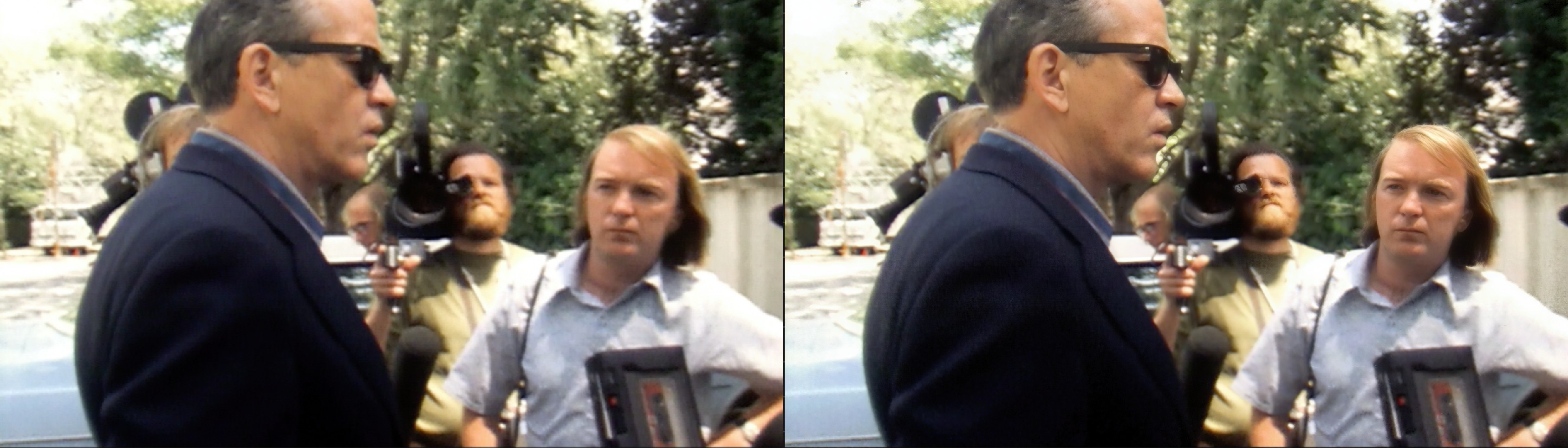
Stone built a shot by shot restoration pipeline around Topaz Video. Because Guerrilla blends 16mm film, broadcast video, still photography, and original interviews, no single model worked across the entire film. He ultimately relied on Topaz Iris, Artemis LQ, and Artemis MQ enhancement models, at times exporting multiple 4K passes and stacking them in Premiere to blend for realism and continuity. For Stone, restraint was essential.
“There’s an artistry to using Topaz Video. Mastering it has become its own post-production skill.”
Lower thirds presented a significant obstacle. The original master had no textless version, and embedded graphics degraded under enhancement. In some cases, Stone returned to Beta SP tapes, digitized them through a legacy deck, converted frame rate externally, and then upscaled again. In others, lower thirds were rebuilt or rotoscoped by hand. Original still photographs were restored and upscaled with Topaz Gigapixel and reanimated. The result was a fully rebuilt 4K master completed entirely in house.
AI as Craft, Not Fabrication
Stone does not ignore the broader debate around AI. “I’m deeply troubled by the implications of AI in completely erasing the ability to distinguish between what’s real and what’s not,” he says. But he draws a clear distinction between fabrication and restoration. For him, enhancing resolution while maintaining authenticity is preservation, not manipulation. “If something has been genuinely faked and presented as real, you should alert your audience. But improving resolution while maintaining authenticity is preservation.”
Reviving a Lost Era of Documentary
Stone has worked across nearly every format transition of the past four decades, from Super 8 and 16mm to MiniDV, DVCPro, DSLR, and now 8K digital cinema. He points to a window between the decline of 16mm and the rise of true high resolution digital capture when documentary image quality declined sharply. That period includes important films now effectively locked in obsolete formats, not for lack of relevance, but for lack of practical restoration options.
“There’s a whole body of work that falls into this black hole,” he says. “Topaz is the only tool I know that can revive them.”
Restoring Guerrilla is part of a broader effort. “I’m now going back and restoring all of my older films using Topaz,” Stone explains. “It’s given new life to films produced using less than optimal video formats of the past.” By keeping the process in house, restoration becomes economically viable rather than aspirational.

Footage once intended for small screens now holds up on large theatrical projection. For Stone, that reflects continuity rather than revision. “Topaz has been a godsend for this type of work. I think anyone working with archival imagery would benefit from employing it in their post production workflow.”
As distribution standards continue to rise, restoration is becoming a practical necessity rather than a luxury. For filmmakers like Stone, Topaz Video makes it possible for legacy and contemporary work to share the same cinematic stage.
Watch Guerrilla: The Taking of Patty Hearst
Available now on streaming platforms:
Amazon | AppleTV | YouTube


